Comprehensive NEMA L6-30 Twist Lock Receptacle Guide
This short guide takes a closer look at the NEMA L6-30 Twist Lock Receptacle. We outline why this 30A 250V twist lock receptacle is preferred in demanding environments. It ensures a secure, locked connection, eliminating the risk of unplugging due to vibration or harsh conditions.
NEMA-stamped and UL-rated devices from brands such as Legrand and Eaton follow strict safety and performance standards. The 30a 250v twist lock receptacle falls within the L6 series, defined by NEMA as a 250V, 30-amp mechanism with a 2-pole, 3-wire setup. This standardized design makes the L6-30 outlet a reliable option for generators, HVAC equipment, and heavy machines.
Targeted at electricians, facility managers, contractors, and procurement teams, this piece provides essential insights. It aims to clarify the process for identifying, wiring, and installing a 30 amp twist lock receptacle. Following sections include tips for identification, recommended wiring practices, mounting approaches, and sourcing from trusted suppliers.
Understanding the NEMA L6-30 Twist Lock Receptacle
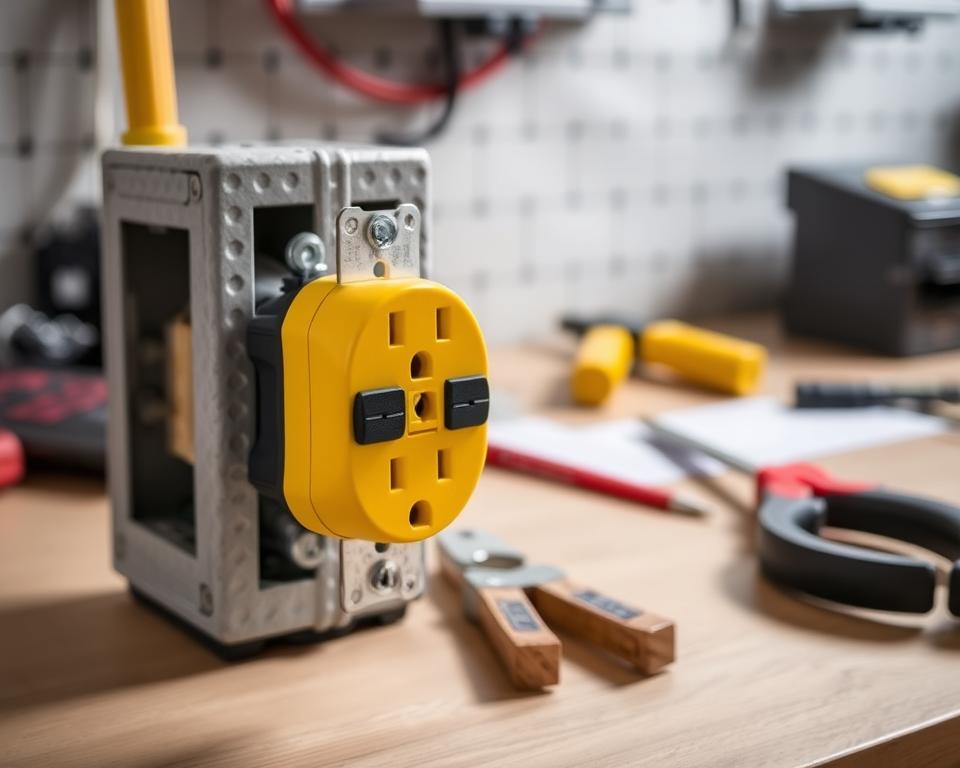
The NEMA L6-30 twist lock receptacle is a key power outlet used for ensuring firm connections. It complies with both NEMA and UL 498 standards, giving electricians critical information such as voltage and amperage via its configuration. You’ll often see it described as an l6 30 receptacle or as a nema l6 30 receptacle in catalogs and listings.
Definition and NEMA designation explained
NEMA markings are used to classify a device’s series, voltage, ampacity, and pin configuration. Specifically, the L6 series denotes 250V single-phase service minus a neutral wire. Devices are labeled L6-30R for receptacles and L6-30P for plug counterparts. Referring to the exact nema l6-30r name allows installers and purchasers to quickly confirm compatibility.
Electrical specs: voltage, amperage, poles, wires
Details for the L6-30 include a 250V AC supply at 30 amps, utilizing a 2-pole, 3-wire setup. This design is perfect for 250V devices requiring a consistent two-hot connection. You’ll frequently see l6 30 receptacle or l6-30 twist lock connector used to describe this configuration in product descriptions.
Twist-lock mechanism operation and importance
Inserting and twisting the plug into the receptacle engages a secure lock thanks to a unique pin pattern. This locking method prevents accidental loosening of the plug during operation. It ensures a safer connection by minimizing arcing and exposure. Therefore, the nema l6-30 twist lock receptacle is a dependable choice for heavy-duty equipment. The design also promotes correct plug insertion, helping to prevent improper connections.
Common Uses and Applications of a 30A 250V Twist Lock Receptacle
The 30a 250v twist lock receptacle excels in environments where secure, vibration-resistant connections are critical. Facilities operating heavy machinery or sensitive tools prefer this locking design to prevent unplugging during use.
In industrial and commercial environments, locking connectors are crucial for dependable electrical power. These connectors are common in data centers, manufacturing facilities, cold-storage rooms, and hospital equipment areas. They help maintain circuit stability during continuous operation.
For 250V loads, equipment such as generators, HVAC systems, welders, and heavy machinery frequently use an l6-30 twist lock socket. It’s also ideal for portable generators and shore-power HVAC connections that do not require a neutral wire.
Construction projects and temporary events demand electrical connections that are both rapid and safe. Contractors favor l6-30 twist lock outlet panels and distribution boxes for lighting, pumps, compressors, and stage equipment. Doing so minimizes the chance of accidental disconnection.
Quick comparison of common uses
| Use case | How twist lock helps | Common connector |
|---|---|---|
| Industrial manufacturing lines | Stops power loss caused by vibration | L6-30 twist lock socket |
| Generator hookups | Allows secure and quick connect/disconnect for temporary power | 30A 250V twist-lock receptacle |
| Refrigeration and HVAC systems | Remains tight under sustained high-load operation | 30A twist lock receptacle |
| Job sites and event setups | Durable, theft-resistant connections for short-term sites | l6-30 twist lock outlet |
Use an L6-30 model when your device needs two hot conductors and a ground at 250V. If your gear needs a neutral conductor or runs at 125/250V, select an L14-series receptacle instead of an L6-30.
Detailed Look at the NEMA L6-30 Twist Lock Receptacle
This section explains the L6-30 device layout, its matching plugs, and how it differs from other 30A locking types. It provides guidance on aligning cords, confirming compatibility, and avoiding unsafe substitutions in generator, HVAC, and industrial setups.
Physical layout and matching plugs
An L6-30 installation pairs a receptacle and plug that share a unique keyed configuration. The L6-30P plug fits exclusively into its counterpart. With pins laid out in an offset circular pattern, the plug locks after a quarter-turn twist. This mechanism prevents unintended disconnections and errors in pairing with other NEMA configurations.
Compatibility and common naming
Product listings may describe this device as an l6-30r receptacle, l6 30r, or nema l630r. Brands including Legrand, Eaton, and Hubbell provide specific plug and receptacle numbers so installers can confirm a proper match. When you encounter l630r references, confirm via datasheet that it is a 2-pole, 3-wire, 250V AC device.
Differences between L6-30 and other 30A locking devices
Not every 30A locking connector is compatible with another. For example, the L5-30 is designed for 125V and uses a different pin arrangement. Meanwhile, the L14-30 accommodates 125/250V and four wires, making it incompatible with the L6-30 model. Always cross-check that l6-30 devices are rated for 30A at 250V and have the correct pin configuration.
Practical check before purchase
- Verify that the device shows L6-30R or L6-30P marking on the body or in documentation.
- Compare the part numbers against those from well-known brands like Hubbell or Eaton.
- Look for UL certification and the 2-pole, 3-wire 250V identification on l6 30r or l630r labels.
Following these verification steps helps you choose the correct connector for your equipment. This approach helps minimize downtime and keeps your installation in line with relevant codes when selecting an l6-30 connector.
Identifying L6-30 Receptacles and Plugs
Identifying an L6-30 device is straightforward with the right knowledge. You’ll notice a circular face paired with a unique keyed pin pattern that locks via a twist action. For quick verification, look for the NEMA identification and the voltage/amperage information, which is usually molded or stamped directly on the device.
First, inspect the face shape and the arrangement of the pins. The circular design and three-contact configuration distinguish L6 units from other types, like NEMA L5 and L14 varieties. Notably, genuine parts will display a clear NEMA certification, the UL logo, and specifications such as 250V and 30A.
Face shape, pin layout, and NEMA markings
Look for a circular face combined with three precisely located blind-mate positions. The pins are arranged uniquely to complement L6-30 twist lock plugs and sockets. Typically, the specific NEMA code, like L6-30R for receptacles or L6-30P for plugs, can be found marked on the device’s flange or body.
Important markings: nema l6-30r, l6-30a, l6-30 twist lock outlet
Markings on the device provide quick confirmation. Aim to locate the exact phrase, such as nema l6-30r receptacle or l6-30a, along with a 250V/30A rating. Retail packages and technical datasheets often highlight these details, simplifying the identification of the correct l6-30 twist lock outlet.
Common product names and part numbers from manufacturers
Brands including Eaton, Legrand, and Hubbell usually include the L6-30R or L6-30P code in their titles. Each brand offers distinct part numbers for different mounting choices, like flush-mount, surface-mount, or outdoor enclosures. Ensure that any l6-30 twist lock plug or socket you purchase matches its UL listing and datasheet details.
Wiring Requirements and Best Practices for NEMA L6-30 Receptacles
Begin the installation of a nema l6-30 receptacle by verifying the circuit type. They operate on 250V at 30A and use a two-pole, three-wire arrangement. This includes two hot conductors and an equipment ground. Remember that a neutral wire is not part of this configuration, so do not substitute a neutral where it doesn’t belong.
Appropriate wire gauge and cable selections
Typically, you’ll select 10 AWG copper wire for a 30A circuit, unless code requirements dictate otherwise. For installations that won’t move, THHN/THWN in a conduit or appropriate cable assemblies are suitable. Where flexibility is required, consider SOOW or SJT cords, verifying that they meet the necessary ratings.
Wire count and terminal practices
Confirm that two hot wires and an appropriately sized equipment ground are present in the installation. Secure terminations to the specified manufacturer torque values, using lugs that match the wire type. Verify that the ground terminal on the receptacle is clean and firmly connected to the chassis or grounding system.
Grounding and NEC considerations
Connect the equipment grounding wire to the ground terminal according to NEC rules. Protect the circuit with a 30A breaker or a properly sized fused disconnect. Verify that the enclosure meets all relevant code criteria for the installation. Always follow UL guidelines and carefully follow the equipment manufacturer’s instructions.
Common wiring mistakes to avoid
- Installing conductors that are too small and prone to overheating under load.
- Confusing L6-30 with L14-30 connections, causing unnecessary or incorrect neutral wiring.
- Omitting the equipment ground, or failing to secure the receptacle grounding properly.
- Using unapproved adapters or improvised connections rather than correct NEMA devices.
- Not installing adequate strain relief, risking conductor damage.
Installation checklist
- Review the circuit rating and equipment requirements before beginning any work.
- Choose 10 AWG copper wiring or larger if needed, and select cable appropriate to your application.
- Install a 30A protective device that complies with NEC and local regulations.
- Carefully shape and secure wires to minimize stress; adhere to torque standards provided by the device maker.
- Check grounding effectiveness and that the setup is correctly listed; conduct tests with and without loads.
Whenever you are unsure, use the NEC as a reference and seek assistance from a licensed electrician. Giving proper focus to a nema l6-30 receptacle installation can reduce the risk of fires, prevent equipment failure, and guarantee the safe use of vital machinery in generators, HVAC systems, and various industrial tools dependent on this specific wiring standard.
Mounting and Installation Options for l6-30r Receptacles
The mounting method you choose plays a major role in keeping a nema l6-30 receptacle installation safe and durable. You may use a flush mount in a standard wall box, or choose a surface-mount design for exposed industrial locations. In outdoor or temporary scenarios, weatherproof l6-30 receptacles are typically the best choice. Every style influences how you handle cable management, strain relief, and environmental sealing.
A flush-mounted l6-30 is recessed, keeping the faceplate flush with the wall surface. It’s often chosen for permanent indoor setups where appearance and physical protection matter.
Surface-mounted l6-30 receptacles are fixed directly to walls or equipment. You frequently see these in mechanical rooms and workshops where exposed conduit runs are typical.
Weatherproof l6-30 receptacles use sealed enclosures with protective covers. They’re ideal for use with outdoor generators, at events, and where exposure to elements is a concern.
Step-by-step installation overview for licensed electricians
- De-energize the circuit and verify it is off using a dependable test instrument.
- Pick a device and enclosure that meet 250V/30A specifications and are suitable for the setting.
- Use properly sized conductors, such as 10 AWG copper for a 30A branch circuit, or THHN/THWN in conduit.
- Connect the two hot conductors to the marked hot terminals and attach the ground wire to the ground terminal, following the manufacturer’s torque guidance.
- Implement strain relief or a conduit connector at the box. Install the device and ensure all openings are sealed for outdoor installations.
- Re-energize the circuit and test it with either a receptacle tester or a compatible load for 250V setups.
When to involve a licensed electrician and important code notes
Contact a licensed electrician if you’re unsure about the circuit layout, neutral versus non-neutral paths, or have questions about meter or panel capacity. Professionals not only guarantee a correct nema l6-30 receptacle install but also handle necessary official documentation.
Make sure you comply with NEC standards for breaker sizing, conductor capacity, box fill, grounding, and device specifications. Ensure all devices are UL-listed, follow the manufacturer’s instructions, and check for local code updates before completing your l6-30 receptacle installation, whether flush or weatherproof.
How to Choose the Right l6-30 Twist Lock Connector and Accessories
Choosing the correct l6-30 twist lock connector and associated accessories is essential. This helps keep equipment running smoothly while maintaining safety. It’s critical to match the device with its intended application, verify its ratings, and avoid non-standard adapters. Selecting reputable brands like Legrand, Eaton, and Hubbell supports reliable performance and UL compliance.
Receptacle vs inlet vs connector vs adapter
The receptacle is the outlet body that mounts to a wall or panel. An inlet, by contrast, is used as a power entry point on generators or transfer equipment. The connector typically is the female component on the cable that connects to a plug. The plug, being the male end, fits into a receptacle or inlet.
Using l6-30 adapters not endorsed by NEMA or UL-listed is risky. Such non-compliant adaptations can cause loose connections, increased resistance, and the danger of overheating.
Choosing locking receptacles, plugs, and strain relief
Select rugged l6-30 plugs and connectors that use solid contacts and tough metal or high-quality thermoplastic shells. Make sure there are cord clamps or strain-relief fittings that properly fit the cable’s outer jacket.
When equipment is used frequently, it’s wise to choose models with replaceable contacts and easy-to-read NEMA markings. Make sure the selected l6-30 inlet or receptacle supports 250V/30A and matches your l6-30 plug and connector precisely.
Weatherproofing, covers, and cable compatibility
Outdoor or temporary installations require weatherproof covers and sealed enclosures rated for wet or damp conditions. Select SOOW or other rated outdoor cables that work properly with your l6-30 connector and strain relief.
If you are connecting a generator, ensure the inlet orientation is correct and that any l6-30 adapter is UL-listed for generator use. Matching the plug, connector, inlet, and receptacle correctly minimizes wiring errors and fire hazards.
| Item | Typical Use | Key characteristic |
|---|---|---|
| l6-30 receptacle | Fixed wall/panel outlets for 250V tools and equipment | NEMA marking, flush/surface options, UL-listed |
| L6-30 inlet | Generator or transfer switch power entry | Panel-mount design, available weatherproof models |
| l6-30 connector | Cable-mounted female device for cordsets | Cord-grip, reinforced contacts, strain relief |
| L6-30 plug | Male cable end for equipment or extension cords | Locking engagement, heavy-duty molded housing |
| L6-30 adapter device | Occasional change of plug style, limited use cases | Only use UL-listed adapters that preserve amp/volt rating |
| Accessories for L6-30 twist lock receptacles | Covers, strain-relief kits, replacement parts | Weather-resistant covers and compatible cord grips |
Where to Buy Wholesale l6-30 Receptacle Parts and Find Trusted Suppliers
For bulk orders of l6-30 receptacle components, look to reputable manufacturers such as Legrand, Eaton, and Hubbell. These companies offer UL-listed catalog numbers for L6-30 plugs, L6-30 receptacles, and connectors. This simplifies the process when seeking an l630r receptacle or a nema l6-30r receptacle.
Using distributor catalogs and NEMA charts helps ensure you meet compatibility and rating requirements. When searching for products, always use the exact NEMA codes L6-30R and L6-30P. This step confirms that the voltage and amp rating suit your application. Suppliers such as StayOnline provide detailed configurations and datasheets. This allows you to check the mounting style and weather rating before purchasing.
When purchasing wholesale, contact Installation Parts Supply for competitive pricing and help with ordering. Provide the precise NEMA codes and state any preference for brands like Eaton, Legrand, or Hubbell. In addition, specify whether you need flush, surface, or inlet mounting. Doing so ensures an accurate quote and a parts list that matches your needs.
Always verify that the product has a UL listing and NEMA stamp before making a purchase. Check that it’s rated for 250V/30A, and request the manufacturer’s part numbers. Stay away from non-listed adapters and request supporting documentation from suppliers. This helps ensure your installation remains safe and compliant with regulations when you purchase l6-30 receptacle components.