Engineering Solutions for Precision: CNC-Machined Precision Parts
Roughly seven in ten of contemporary critical assemblies rely on stringent tolerances to meet safety/quality and performance targets, underscoring how minor deviations influence outcomes.
High-accuracy titanium machining manufacturing improves overall reliability and service life across automotive, medical, aerospace, and electronic applications. It provides repeatable mating, quicker assembly, and reduced rework for assembly/test teams.
This section presents UYEE-Rapidprototype.com as a partner dedicated to satisfying stringent requirements for regulated industries. Their workflows combine CAD/CAM, reliable programming, and stable systems to reduce variation and speed time to market.
This guide helps US buyers evaluate options, establish clear requirements, and select capabilities that fit projects, budgets, and timelines. Use this practical roadmap that covers specifications and tolerances, machines and processes, material choices and finishing, industry use cases, and pricing drivers.
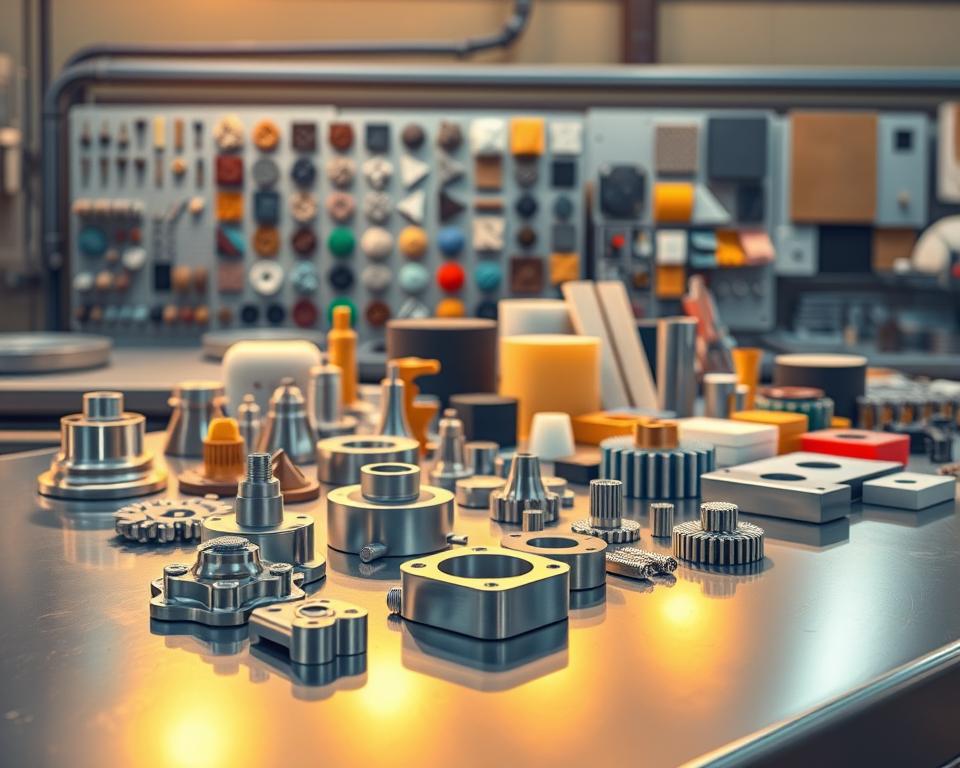
- Precision and repeatability enhance reliability and decrease defects.
- Model-based CAD/CAM workflows drive consistent manufacturing throughput.
- UYEE-Rapidprototype.com positions itself as a reliable partner for US buyers.
- Explicit, measurable requirements help match capabilities to project budgets and timelines.
- Optimized processes cut waste, speed assembly, and reduce TCO.
Buyer’s Guide Overview for CNC Precision Machined Parts in the United States
US manufacturers require suppliers providing consistent accuracy, repeatability, and reliable schedules. Buyers want clear schedules and conforming parts so operations remain on plan.
Current buyer priorities: accuracy, repeatability, lead time
Key priorities include tight tolerances, consistent batch-to-batch repeatability, and lead times resilient to demand changes. Mature quality controls and a disciplined system minimize drift and boost assurance in downstream assembly.
- Accuracy that meets drawings and function.
- Repeatability at scale that reduces inspection risk.
- Predictable lead times and open communication.
How UYEE-Rapidprototype.com supports precision engineering projects
The team provides timely quotes, design-for-manufacture feedback, and schedules aligned to requirements. Workflows leverage validated processes and stable programming to minimize schedule slips and rework.
Bar-fed cells and lights-out automation enable scalable production with shorter cycles and stable precision when volume ramps. Up-front alignment on drawings/FAI maintains inspection/sign-off timing.
| Capability | Buyer Benefit | When to Specify |
|---|---|---|
| Validated processes | Lower defect rates, predictable yield | High-risk assemblies and regulated projects |
| Lights-out automation | Faster cycles, stable accuracy | Large or variable volume production |
| Responsive quoting & scheduling | Faster time-to-market, fewer surprises | Rapid prototypes, tight schedules |
Selection Criteria & Key Specifications for CNC Precision Machined Parts
Defined, testable criteria turn drawings into reliable production outcomes.
Tolerances, surface finish, and repeatability benchmarks
Specify precision machining tolerance targets for critical features. As tight as ±0.001 in (±0.025 mm) are attainable when machine capability/capacity, workholding, and temperature control are qualified.
Align surface finish with function. Apply grinding, deburring, polishing to reach roughness ranges (Ra ~3.2 to 0.8 μm) for seal or low-friction surfaces on a workpiece.
Production volume and lights-out scalability
Match machines and workflows to volume. For repeated high-volume orders, specify 24/7 lights-out cells and bar-fed setups to maintain steady throughput and speed changeovers.
Quality systems and in-process inspection
Mandate acceptance criteria with GD&T and FAI. In-process checks detect drift early and safeguard repeatability while running.
- Use CAD/CAM simulation to optimize toolpaths and reduce rounding errors.
- Verify supplier certifications such as ISO 9001 or AS9100 and metrology assets.
- Record sampling/control plans per end-use needs.
Drawings are reviewed by UYEE-Rapidprototype.com against these targets and suggests measurable requirements to reduce purchasing risk. This stabilizes production and improves OTD.
Processes & Capabilities for Precision
Combining five-axis machining, live tooling, and finishing lines lets shops deliver production-ready components with fewer setups and less handling.
Multi-axis milling and setup efficiency
Five-axis with ATC handles five sides in one setup for complex features. VMCs and HMCs enable drilling with efficient chip evacuation. This reduces repositioning and improves feature-to-feature accuracy.
Turning/Swiss for small precise work
Turning centers with live tooling can remove material and add cross holes or flats without secondary ops. Swiss methods are used for slender/small parts in volume runs with excellent concentricity.
EDM / Waterjet / Plasma & finishing
Wire EDM creates fine forms in hard metals. Waterjet avoids HAZ for sensitive materials, and plasma cuts conductive metals efficiently. Final finishing—grinding, polishing, blasting, passivation optimize surface and corrosion performance.
| Capability | Best Use | Buyer Benefit |
|---|---|---|
| Five-axis & ATC | Complex, multi-face geometry | Fewer setups, faster cycles |
| Live tooling & Swiss turning | Small, complex high-volume | Volume cost savings, tight runout |
| Non-traditional cutting | Hard or heat-sensitive shapes | Accurate profiles with less rework |
UYEE-Rapidprototype.com combines these capabilities and controls with disciplined machine maintenance to protect repeatability and schedules.
Choosing Materials for Precision
Material selection determines whether a aluminum CNC machining design meets performance, cost, and schedule targets. Selecting early cuts iterations and aligns manufacturing with performance goals.
Metals: strength/corrosion/thermal
Typical metals include Aluminum 6061/7075/2024, steels such as 1018 and 4140, stainless 304/316/17-4, Titanium Ti-6Al-4V, copper alloys, Inconel 718, and Monel 400.
Compare strength-to-weight and corrosion behavior to meet the use case. Plan rigid fixturing and temperature control to hold tight accuracy when removing material from tough alloys.
Plastics for engineering uses
ABS, PC, POM/Acetal, Nylon, PTFE (filled/unfilled), PEEK, PMMA fit numerous applications from enclosures to high-temperature seals.
Engineering plastics are heat sensitive. Reduced feeds and conservative RPM preserve dimensions and finish on the part.
- Weigh metals by strength, corrosion, cost to choose the right material class.
- Choose tools/feeds appropriate for Titanium/Inconel to cut cleanly and extend tool life.
- Choose plastics for low-friction/chemical resistance, tuning parameters to prevent warp.
| Class | Best Use | Buyer Tip |
|---|---|---|
| Aluminum/Brass | Lightweight housings, good machinability | Fast cycles; verify temper/finish |
| Steels/Stainless | Structural, corrosion resistance | Plan thermal control/hardening |
| Titanium & Inconel | High-strength, extreme service | Expect slower feeds, higher tool cost |
UYEE-Rapidprototype.com helps specify material and testing coupons, document callouts (temperature range, coatings, hardness), and match machines and tooling to the selected materials. That guidance shortens validation and lowers redesign risk.
CNC Precision Machined Parts
A clear CAD model and smart toolpath planning cut iteration time and protect tolerances.
CAD is translated to CAM by UYEE-Rapidprototype.com that produce optimized G/M code with simulated toolpaths. This flow lowers rounding error, reduces cycle time, and keeps accuracy tight on the workpiece.
DFM: CAD/CAM, toolpaths & workholding
Simplify features, choose stable datums, align tolerances to function so inspection stays efficient. CAM toolpath strategy with cutter selection limit idle time and wear.
Use rigid tool holders, proper fixturing, and ATC to speed changeovers. Early collaboration on threaded features, thin walls, deep pockets helps avoid deflection and finish issues.
Industry applications: aerospace, automotive, medical, electronics
Use cases span aerospace structures/turbine blades, auto engine parts, medical implants, and electronics heat sinks. Each sector enforces unique traceability/cleanliness needs.
Cost levers: cycle time, material utilization, and reduced waste
Efficient milling strategies, better chip evacuation, and nesting for plate stock cut scrap and material cost. Planning from prototype to production keeps fixtures/machines consistent to maintain repeatability during scale-up.
| Focus | Buyer Benefit | When to Specify |
|---|---|---|
| DFM-driven design | Quicker approvals with fewer changes | Quote stage |
| CAM/tooling optimization | Lower cycle time, higher quality | Pre-production |
| Nesting and bar yield | Waste reduction and lower cost | Production runs |
UYEE-Rapidprototype.com acts as a DFM partner, providing CAD/CAM optimization, fixture guidance, and transparent costs from prototype to production. The disciplined system keeps projects predictable from RFQ to steady FAI.
Wrapping Up
Summary
Consistent tolerance control with disciplined workflows translates intent into repeatable outputs for demanding industries. Process discipline and robust controls with proper equipment deliver repeatability on critical components across medical, aerospace, automotive, electronics markets.
Proven capability plus clear requirements, validated by data-driven inspection, protects quality and schedule/cost goals. Advanced milling/turning with EDM, waterjet, and finishing—often combined—cover broad part families and complexities.
Material choices from Aluminum/stainless to high-performance polymers ought to fit function, budget, and lead time. Thoughtful tool choice, stable fixturing, and validated programs reduce cutting time and variation so every part meets spec.
Submit CAD/drawings for DFM review, tolerance checks, and a prototype-to-production plan. Connect with UYEE-Rapidprototype.com for consultation, tailored quotations, and machining aligned to your inspection and acceptance criteria.