What if a single small fitting could help ensure both protection and durability in your plumbing system? This question is central to choosing the right components for any project.
Check out 3 8 Female To 1 2 Female Adapter
One of the essential products available from Installation Parts Supply is the Compression Outlet Lead Free Brass Max-Adapter. As a reliable source for plumbing products, we offer this item to help create secure and leak-free joints.
Manufactured from lead-free brass, this fitting satisfies demanding safety standards for drinking water systems. Its durable construction is intended to provide extended service life and dependable protection against corrosion.
This adaptable fitting performs well in a wide range of applications. From household water lines to hydraulic systems, it delivers reliable performance every time.
This adapter is stocked by Installation Parts Supply as part of our broad plumbing supply selection. We are a trusted source for contractors and DIY users looking for reliable fittings.
This introduction highlights the adapter’s role in modern plumbing. The next sections will take a closer look at its features, technical details, and recommended applications.
Introduction: Your Go-To Source For Plumbing Supplies
For both plumbing professionals and DIYers, securing a reliable supplier for essential components is an important first move. The right supplier helps give your project a strong foundation from day one.
Installation Parts Supply serves as a premier wholesale distributor for all your plumbing component needs. We focus on supplying the fittings and parts that help plumbing systems perform efficiently.
We are committed to offering high-quality, code-compliant products for every type of project. From residential improvements to large-scale commercial work, we carry the right item for the task.
Sourcing reliable fittings is especially vital for critical systems like potable water lines. One poor connection may put both reliability and safety at risk.
For that reason, our inventory includes a wide variety of tube sizes and material types. This allows you to locate the precise specifications your application requires without unnecessary delays.
Choosing a knowledgeable supplier can make a major difference. We combine strong technical support with fair pricing to better serve our customers.
Our product lineup closely follows strict U.S. plumbing standards. This means we prioritize lead-free brass components that offer both safety and long-term strength.
We have earned a reputation as a trusted authority in the plumbing supply field. Customers trust us to deliver correct information and the proper parts for the job.
Whether the work involves new installations, repairs, or routine upkeep, we stock the needed parts. Our aim is to serve as your one dependable source for every project.
Our commitment to service and product quality supports everything we offer. In the next section, we will take a closer look at one especially versatile fitting.
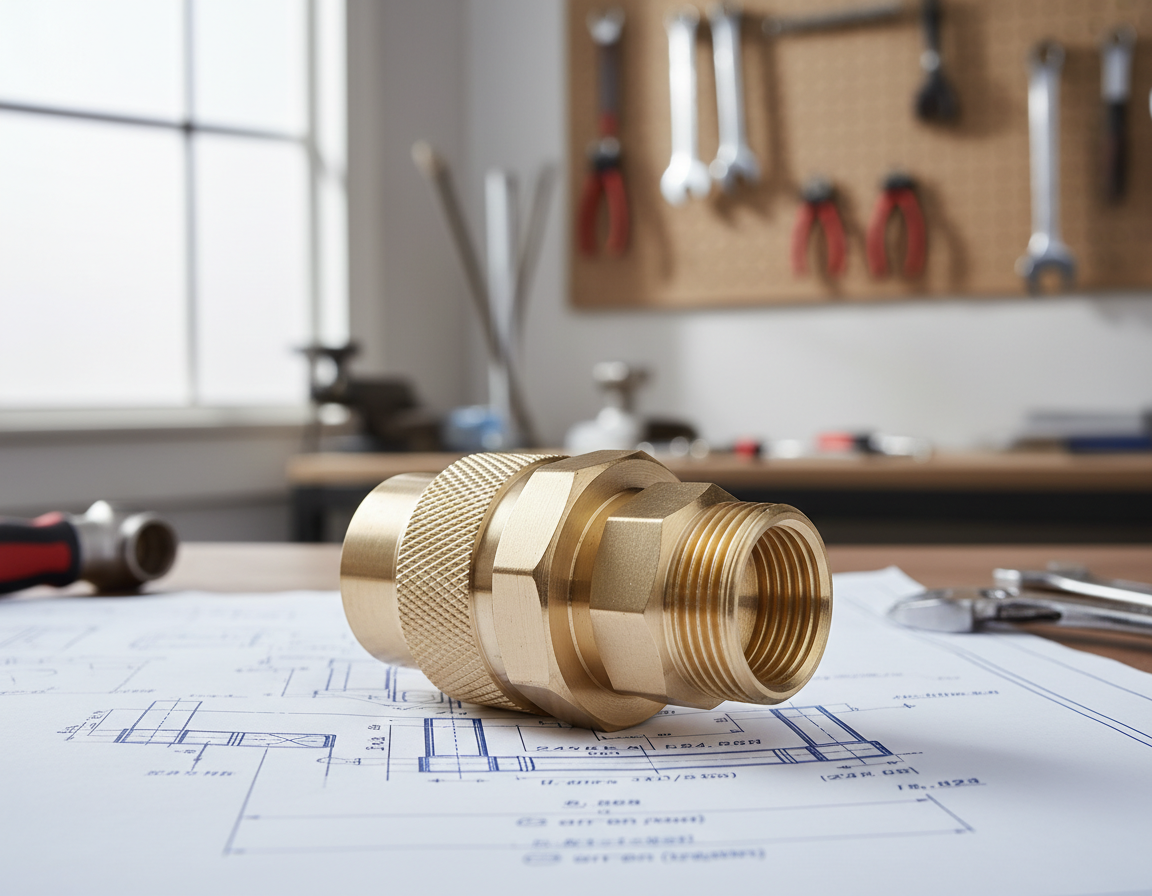
What Is A Compression Outlet Lead Free Brass Max-Adapter?
A specialized connector is used in many systems to join smooth tubing with threaded pipe ports. This component is called a compression outlet lead-free brass max-adapter.
It is a specific kind of compression fitting. Its basic purpose is to join a tube to a male pipe thread, often identified as an MIP.
Core Function And Design
This component creates a reliable, sealed transition. It connects a smooth tube end directly to a threaded port.
No soldering or flaring is needed during the process. This makes it a favorite for many installers.
The sealing method uses mechanical force to produce a secure joint. The nut and sleeve, often referred to as the ferrule, operate together in the sealing process.
You begin by sliding the nut onto the tube and then adding the sleeve. Then, you insert the tube end into the fitting body.
As the nut tightens, the sleeve is forced against the tube and fitting body. This gripping motion holds the tube in place and creates a leak-resistant seal.
This method works on copper, polyethylene, and PEX tubing. It is a common choice for creating secure water connections.
A significant benefit is that specialized tools are not needed. Standard wrenches are typically all that is required for installation.
Another practical feature is that the fitting can be taken apart easily. If future service or line modification is needed, you can just loosen the nut.
Compliance And Safety
The fitting body is made using a lead-free brass alloy. This is a critical feature for safety, especially with drinking water.
U.S. regulations strictly limit lead content in potable water system components. This product meets those stringent standards.
Using lead-free components reduces the risk of lead leaching into the water. This protects human health and the environment.
Traditional brass alloys often contained more lead. Modern material science has developed excellent alternatives.
These new alloys maintain all the desirable properties of brass. They continue to offer durability, machinability, and corrosion resistance.
They simply do so without the associated health risks. That improvement represents an important advancement for safe plumbing systems.
| Feature | Traditional Brass Alloy | Lead-Free Brass Alloy | Primary Benefit |
|---|---|---|---|
| Lead Content | More than 8% (common) | ≤0.25% weighted average | Eliminates leaching risk |
| Use In Potable Water Systems | Restricted or not recommended | Approved for use | Suitable for potable water applications |
| Resistance To Corrosion | Moderate to good | Excellent (with modern additives) | Longer service life |
| Mechanical Strength | High | Comparably High | Reliable pressure handling |
This type of fitting is ideal where future changes are possible. Its easy disassembly helps support repairs and future maintenance.
In summary, this adapter is a versatile, safe, and user-friendly part. It provides a practical and code-compliant solution for difficult connections.
The Anatomy Of A Compression Fitting
A reliable mechanical seal comes from a clever yet straightforward combination of components. Knowing how these parts work together is essential for a successful installation.
A standard compression fitting includes three basic parts. Those parts are the body, the sleeve, and the nut.
The number of nuts and sleeves corresponds to the number of connection points on the body. This three-piece design is universal for this type of connection.
Body
The body serves as the main component of the assembly. It is the fixed part that contains the connection points.
It is commonly produced from lead-free material and contains a tapered inner seat. That seat is the area where the seal is formed.
One end accepts the smooth end of a tube. The other side generally features a threaded port to connect with another item.
Its durable design helps it manage system pressure and remain securely anchored. Precision machining here is critical for a perfect seal.
Sleeve Or Ferrule
The sleeve, also known as the ferrule, is a small yet essential ring. This piece serves as the primary sealing component in the fitting.
It is often produced from brass or a durable polymer and is installed onto the tubing early in the process. Under compression, it changes shape in a controlled manner.
This process makes the sleeve clamp firmly onto the tube’s outer surface. At the same time, it creates a seal against the body’s tapered seat.
This combined gripping and sealing action is what makes the compression connection work. A properly manufactured sleeve can resist vibration and repeated temperature changes.
Compression Nut
The nut is the component you turn during assembly. It engages with the outer threads on the fitting body.
As the nut is tightened, it travels axially along the tube. This movement forces the sleeve into the tapered seat inside the body.
The applied force is what creates the compression. Proper tightening is essential for achieving a leak-proof seal without damaging the parts.
This design also makes disassembly simple when required. You simply loosen the nut to take the joint apart.
Together, these three parts form a dependable and durable mechanical connection. Each component plays a direct role in the overall performance and lifespan of the compression fitting.
This particular adapter applies the same trusted design while using high-quality parts. That helps provide durability and a dependable seal in plumbing applications.
Key Features Of Our Brass Max-Adapter
The design quality of the parts you use has a direct impact on efficiency at the job site. This particular connector includes features intended to solve common installer problems.
These features offer real benefits, including faster installation and easier long-term maintenance. Let’s explore what makes this product a standout item.
Three-Piece Design
Its construction depends on a straightforward set of three components: the nut, the sleeve, and the body. Every part serves a specific and essential purpose in forming a tight joint.
This efficient approach supports reliable sealing again and again. It also simplifies your inventory, as you only need to manage these three basic pieces.
No Flaring Tool Required
A major advantage is the complete absence of any flaring requirement for the tube. That saves labor time and removes the need to buy a specialized tool.
It also lowers the skill barrier for successful installation. DIY users can often achieve professional-looking results without advanced instruction.
Easy Disassembly For Maintenance
The compression design is naturally easy to service. You can loosen the nut to take the joint apart without damaging the tube.
This allows for repairs or system changes without cutting the line. If reusing the sleeve, it may be wise to replace it to maintain a dependable seal when reassembling.
This feature can significantly reduce downtime during system changes. It provides a level of flexibility that permanent joining methods do not offer.
Taken together, these features help projects move faster while improving future adaptability. The robust lead-free alloy body contributes to the fitting‘s longevity through many cycles.
When practical performance matters in brass compression fittings, this adapter stands out. Installation Parts Supply provides these superior fittings for professionals who value performance and ease.
Technical Specs And Size Guide
Here you will find the precise dimensions and ratings needed for correct installation. Matching your tube and thread requirements to the correct product is essential.
We outline the key technical details for this specific adapter. Use this information to verify it will work in your system.
Size Range: Tube OD And Thread Specifications
This product comes in a broad size range for greater flexibility. It fits tubing with outside diameters ranging from 1/8 inch to 7/8 inch.
At one end, it connects to plain tubing. On the opposite side, it uses a standard Male Iron Pipe (MIP) thread.
These threads follow the National Pipe Taper (NPT) standard. This ensures a universal fit with other common plumbing components.
| Tube Outside Diameter (OD) | Corresponding Thread Size (NPT) |
|---|---|
| 1/8″ | 1/8″ |
| 1/4″ | 1/4″ |
| 3/8″ | 3/8″ |
| 1/2″ | 1/2″ |
| 5/8″ | 1/2″ |
| 3/4″ | 3/4″ |
| 7/8″ | 3/4″ |
Installation Parts Supply keeps these adapters in the most commonly used sizes ready for shipment. Always double-check your tube OD before ordering.
Temperature Range: -40°F To +250°F
This adapter is designed for a broad operating temperature range. Its reliable operating range extends from -40°F up to +250°F.
That temperature capability makes it suitable for nearly all home and commercial settings. It handles freezing conditions as well as hot water line duties.
This rating reflects both the stability of the material and the integrity of the joint. This makes it dependable in both freezing and elevated-heat conditions.
Material: Lead-Free Brass Alloy
The fitting body is manufactured from a certified lead-free brass alloy. This material makeup plays a critical role in safe operation.
This material meets strict requirements including NSF/ANSI 61-G. These are for components in contact with drinking water.
Using lead-free components helps stop contaminants from leaching into the water. It protects household health and meets all current U.S. plumbing codes.
The alloy also offers strong durability and excellent corrosion resistance. This allows the item to provide extended use over time.
In summary, these technical specs define a versatile, safe, and robust connector. Its proper size options, broad temperature tolerance, and safe brass construction support a dependable installation.
Applications: Where This Adapter Works Best
The true value of a plumbing component is revealed by the diverse tasks it can handle reliably. This fitting is built for a broad selection of applications that extend beyond standard water service.
Its durable design enables it to handle various media such as liquids, gases, and fuels. That makes it a practical item for residential, commercial, and industrial use.
Its usefulness is evident in everything from household drinking water systems to factory machinery. Let’s review the main systems in which this adapter performs especially well.
Use In Potable Water Systems
Delivering safe drinking water is a top priority for any plumbing system. For this critical application, the adapter is a strong choice.
Its lead-free design complies with health requirements for potable water. It can be installed confidently on both hot and cold water supply lines.
The fitting performs reliably within its broad temperature rating. Common installations include homes, apartments, and restaurant plumbing systems.
Whether joining copper or other approved tubing, it supports a secure seal without contamination. That application shows how important the fitting is for safeguarding public health.
Gasoline, Oil, And Vacuum Lines
This adapter is not limited to water-based systems. It also performs well with hydrocarbons such as fuels and lubricants.
Its durable material resists wear caused by gasoline and oil exposure. This makes it suitable for automotive fuel lines or equipment lubrication systems.
It also creates an excellent seal for vacuum applications. Such performance is valuable in laboratory equipment and some HVAC applications.
The mechanical grip maintains integrity under varying pressures. That reliability is important for both safety and system performance in these settings.
Hydraulic And Pneumatic Uses
In industrial and mechanical settings, this connector finds more use. It is often employed in low-pressure hydraulic and pneumatic systems.
Hydraulic systems use fluid to transmit power in machinery. Pneumatic systems do the same with compressed air.
This fitting works well for connecting tubing in these mechanical and control networks. Common examples include manufacturing equipment and instrumentation panels.
Its ability to create a tight seal helps prevent leaks that could lower system efficiency. For each of these applications, selecting the correct tube material is the next vital step.
Compatibility With Copper, Aluminum, And Plastic Tubing
This adaptable connector is intended for use with multiple common tubing materials. Each type has specific considerations for a proper seal.
Using the correct procedures for your tube material is essential. It guarantees the joint performs as intended under pressure.
Copper Tubing (K, L, M, And ACR Types)
These fittings are fully compatible with all standard copper pipe. Compatible options include K, L, M, and ACR (Air Conditioning and Refrigeration) copper tubing.
The solid, rigid nature of copper makes it a strong match for this style of connection. The metal sleeve grips the pipe’s exterior firmly.
These applications are best suited for low-pressure systems without significant vibration. For best results, the pipe end should always be cut square and deburred before assembly.
Aluminum Tube Applications
Aluminum tubing can be used, but it is less frequently seen in standard plumbing work. Because aluminum is softer, extra care is needed during installation.
Selecting the correct sleeve for aluminum applications is very important. Overtightening can quickly deform or damage the softer tube wall.
Plastic Tubing (With Sleeves And Inserts)
Connections to plastic tubing like PEX or polyethylene require additional specialized parts. A standard metal sleeve is not suitable here.
A brass sleeve can bite into the soft plastic wall, causing leaks and eventual failure. You must use a Delrin or similar plastic sleeve, often called a 60P sleeve.
Even more importantly, a stiffening insert is required. This insert, like a 61P model, slides inside the tube end.
It supports the tube internally so it does not collapse under compression. The sleeve then grips the reinforced tube effectively.
When working with larger plastic tubing sizes of 1/2″ OD and above, different connection methods may be preferable. Push-fit or crimp fittings can provide more dependable results on larger lines.
Use the following practical guidance to achieve a successful installation each time:
- Be sure to match the sleeve material to your tube material. Use metal sleeves for metal tubing and plastic sleeves for plastic.
- Be sure to use a stiffening insert with any non-rigid plastic tube. It is essential if you want a reliable long-term seal.
- Confirm the adapter size against your tube‘s outside diameter before assembly.
Installation Parts Supply provides the adapter, the proper Delrin sleeves, and the required stiffening inserts. We supply all related parts so your project can be completed through one reliable source.
Step-By-Step Installation Instructions
Correct installation is the final essential step for ensuring your fittings perform properly. Following a clear sequence guarantees a secure, leak-free joint every time.
These directions apply to connections involving copper, aluminum, or properly prepared plastic tubing. Below is a complete walkthrough of the installation process.
Cutting And Preparing The Tubing
Begin with a clean, precise cut on your tube. A sharp tube cutter is the best tool for this job.
Rotate the cutter around the pipe to score it evenly. Tighten it a little at a time as you rotate until the tube separates.
That process produces a clean, square end. A crooked cut will prevent the sleeve from sealing correctly.
Next, remove any internal burrs left from cutting. A reaming tool or round file can be used for this step.
Keeping the interior smooth helps maintain unrestricted flow. It also ensures the stiffening insert seats fully in plastic tubing.
Clean the outside of the pipe thoroughly. This removes dirt or debris that could interfere with the seal.
Assembly Of Nut, Sleeve, And Body
Collect the three parts needed: the nut, the sleeve (ferrule), and the fitting body. Make sure the tapered end of the sleeve points toward the body.
Start by sliding the compression nut onto the pipe. Next, place the sleeve onto the pipe behind the nut.
Now, insert the pipe end into the fitting body. Insert it completely until it bottoms out inside the fitting.
You will usually feel firm resistance at that point. This full insertion is non-negotiable for a proper compression seal.
If you’re connecting to a male iron pipe (mip) thread, ensure the adapter body is firmly seated in its port first.
Torque And Tightening Tips
Thread the nut onto the fitting body by hand. Rotate it clockwise until it feels snug.
Check that the threads are threading smoothly. Cross-threading should be avoided because it can damage the joint.
After hand-tightening, you can proceed to the final stage. Use an adjustable wrench or pliers for this.
Keep the fitting body stable by holding it with another wrench. This keeps the body from twisting and reduces stress on connected parts.
Use the wrench to tighten the nut. For most connections, about a half-turn (1/2) is generally sufficient.
Sometimes another quarter-turn (0.25) is needed. The total wrench movement should not exceed three-quarters of a turn.
The seal is created by compression, not extreme force. Over-tightening can deform the sleeve or crush the tube, causing leaks.
Thread sealant such as Teflon tape is not required on these compression fitting threads. A small drop of light oil on the nut threads can make assembly easier.
| Step | Action | Key Tip |
|---|---|---|
| 1. Preparation | Cut the tube square, ream the inside, and clean the exterior. | Use a tube cutter for best results. |
| 2. Component Order | Install the nut followed by the sleeve on the tube. | Make sure the sleeve taper faces the fitting body. |
| 3. Insertion | Push tube into body until it stops. | Make sure the tube reaches the internal seat completely. |
| 4. Hand Tighten | Thread nut on by hand until snug. | Check for smooth thread engagement. |
| 5. Wrench Tighten | Apply wrench for final torque. | Typically 1/2 to 3/4 turn maximum. |
| 6. Verification | Inspect the joint and perform a leak check. | Remember that compression, not excessive force, creates the seal. |
These steps help produce a professional-level installation. This method reduces callbacks and ensures long-term system integrity.
Keep in mind that proper technique matters just as much as the correct part. Installation Parts Supply offers both dependable components and the knowledge needed for success.
Understanding OD Vs. CTS Sizes
There are two sizing systems for copper tubing, and knowing which one applies is essential. This distinction often causes confusion in plumbing work.
Using the wrong standard can result in mismatched parts and leaking joints. The following explanation helps make those key terms clear so the right fitting can be selected.
OD (Outside Diameter) Explained
Outside Diameter is the real physical measurement across the tube. You measure it with a caliper or a ruler.
This dimension is always used to specify compression fitting sizes. The adapter has to match the pipe’s precise OD to seal correctly.
OD can be thought of as the actual, real-world size of your tube. It is the only number that matters when buying these connectors.
CTS (Copper Tubing Size) Explained
Copper Tubing Size is a traditional nominal sizing standard. This is commonly known as the nominal size.
For standard copper water tubing, CTS is generally about 1/8 inch smaller than the true OD. This is simply an industry naming convention rather than a direct physical measurement.
For instance, tubing labeled “1/2-inch CTS” actually has an outside diameter of 5/8 inch. This distinction is vital for part selection.
| Tube Outside Diameter (OD) | Copper Tubing Size (CTS) | Common Application Note |
|---|---|---|
| 3/8″ | 1/4″ | Small supply lines |
| 1/2″ | 3/8″ | Often used for valves |
| 5/8″ | 1/2″ | Standard water line |
| 3/4″ | 5/8″ | Larger supply runs |
| 7/8″ | 3/4″ | Main lines, some appliances |
Common Size References For Plumbing
For a brass adapter, the marked size indicates the tube OD it fits. It does not refer to the CTS.
As one example, a nominal 1/2″ copper water line has an outside diameter of 5/8″. That means you need a connector sized for 5/8″ OD rather than 1/2″.
Our product line is labeled according to tube OD. This removes guesswork and ensures compatibility.
Always determine your tube type and measure the outside diameter. That simple step helps avoid installation mistakes.
Connecting to a male iron pipe thread (MIP) requires the correct adapter. The tube end needs to seat tightly inside the compression body.
Matching the OD ensures that the sleeve can grip the tubing properly. A correct grip is essential for forming a watertight connection.
Understanding this is essential for a successful leak-free installation. Be sure to confirm sizes before finishing the connection.
Why Lead-Free Brass Matters For Potable Water
When a fitting comes into contact with drinking water, its material composition matters just as much as its performance. Modern plumbing codes reflect that concern by requiring safer materials to protect health.
Certified lead-free alloy components have become standard practice for important reasons. That approach provides the combined advantages of safety, longevity, and regulatory compliance.
The advantages extend from the tap in your home to the broader environment. Choosing the correct material is a smart and responsible long-term decision.
Health And Environmental Benefits
Traditional brass alloys contained a percentage of lead to improve machinability. As time passed, this lead could enter the flowing water through leaching.
Low-level exposure still presents meaningful health risks, especially for children. It can affect neurological development and cause other long-term issues.
Switching to lead-free brass eliminates this contamination risk at the source. The water remains pure and safe for drinking and cooking.
This decision also helps the environment. It reduces the amount of lead entering wastewater streams and ecosystems.
Safer manufacturing and recycling processes are additional pluses. This makes the overall product lifecycle more sustainable.
Meeting US Plumbing Standards
In the U.S., strict laws regulate the materials used in drinking water systems. The Safe Drinking Water Act provides the basis for those rules.
Specific certifications like NSF/ANSI 61, Section 9 are crucial. They verify that a product’s lead content is within the legal safe threshold.
All brass compression fittings supplied by Installation Parts Supply meet these rigorous standards. They are suitable for potable water applications with confidence.
This compliance is not optional for professional installations. It is necessary for protecting public health and meeting inspection requirements.
Our products include the required certifications for added peace of mind. Every component we offer is selected to meet code requirements.
Durability And Resistance To Corrosion
In addition to safety, this modern alloy provides excellent physical properties. It provides excellent resistance to corrosion and scaling.
That means the fittings can remain intact for years, even under harsh water conditions. This leads to a dependable, long-term connection.
The material performs well across a broad range of pressures and temperatures. It resists degradation and brittleness over time.
When compared to common alternatives, its strengths are clear. The table below outlines some of the key differences.
| Material | Key Advantage | Typical Use Case | Consideration for Potable Water |
|---|---|---|---|
| Lead-Free Brass | Superior strength & temperature tolerance | Hot/Cold water lines, Hydraulic connections | Approved and safe for potable water; ideal choice. |
| Plastic (e.g., PVC) | Low cost & chemical resistance | Drain lines, Irrigation | Not suitable for hot water and may affect taste. |
| Carbon Steel | Very high pressure rating | Industrial gas applications | Susceptible to rust and not suitable for water. |
While the initial cost may be slightly higher than plastic, the value is undeniable. The long service life, safety, and reliability help make it a worthwhile investment.
Choosing certified free brass components is a future-proof decision for any project. This supports health protection today and long-lasting performance in the future.
Installation Parts Supply is dedicated to supplying these high-quality, code-compliant products. We help customers create systems that are durable and safe.
Why Installation Parts Supply Is Your Best Choice
In the world of plumbing installations, where you buy your fittings is as critical as which fittings you buy. The supplier behind the product affects reliability, stock availability, and customer support.
There is a reason Installation Parts Supply stands out as a leading wholesale distributor. Our reputation is built on quality, value, and excellent service for every customer.
Our role goes beyond simply selling parts. We support you throughout the project to help deliver a successful result.
Quality Control And Product Sourcing
Each item in our inventory is carefully verified. We source exclusively from reputable manufacturers known for their high standards.
As a result, each compression fitting and adapter is built to meet or exceed industry specifications. You get components designed for long-term durability and code compliance.
For example, our lead-free brass products include official ratings such as NSF/ANSI 61-G. That helps confirm their safety for potable water applications.
In addition, we carry all required complementary parts. This includes the correct sleeve for your tube type and stiffening inserts for plastic tubing.
Competitive Pricing And Stock Availability
At Installation Parts Supply, we believe value matters. We aim to provide excellent quality without charging excessive prices.
We maintain an extensive in-stock selection of the most popular sizes and types. That includes a complete selection of connectors for copper, plastic, and other tubing.
From a common 1/2″ mip adapter to a more specialized item, we are likely to have it available for shipment. This reduces project delays and keeps your work on schedule.
Our logistics network ensures prompt delivery to job sites across the country. This helps make sure the right parts arrive at the right time.
Technical Support And Customer Service
Technical questions are welcomed by our trained staff. We understand the details of compression connections and thread standards.
We can guide you toward the correct product for your particular application. We also provide advice on installation methods to help prevent leaks.
That assistance extends from nut tightening guidance to selecting the correct mip or other thread option. We ensure you have the knowledge for a successful end result.
Customer service remains a top priority at Installation Parts Supply. We are available to help with order placement, shipment tracking, and post-purchase questions.
| Supplier Attribute | Typical Hardware Store | Online Marketplaces | Installation Parts Supply |
|---|---|---|---|
| Quality Assurance | Varies; mixed brands | Unverified; possible counterfeit risk | Rigorous; sourced from trusted makers |
| Price Competitiveness | Higher retail markup | Low price, but hidden costs | Wholesale value; consistent and fair |
| Product Availability | Limited common sizes | Potentially long shipping times | Extensive in-stock inventory |
| Technical Expertise | Basic general support | Minimal to none | Specialized plumbing and fitting support |
| Code Compliance | Not always guaranteed | Often uncertain | Fully documented and certified |
As the comparison shows, we offer a balanced, professional-quality solution. Customers benefit from dependable product ratings and clear performance data on every order.
Installation Parts Supply is your one-stop shop for all compression fittings needs. From the adapter to sleeves, inserts, and tools, we carry everything you need.
Make us your source for the next project. See the difference a focused, customer-first supplier can make.
Conclusion: Reliable Plumbing Solutions
The final objective for both professionals and DIY users is a leak-free plumbing system. The right adapter ensures safety and durability for water, gas, or air lines.
This product offers lead-free construction for potable water safety. Its durable design can handle different fluids while keeping installation straightforward.
Always match the tube’s outside diameter and use proper techniques. Correct fitment is essential for avoiding leaks at each connection end. Always prepare the tube end properly before assembly.
This applies to plastic tubing and other materials. Always use the proper sleeve with plastic lines.
For male iron pipe (mip) threads, ensure a secure seal. Make sure the mip connection is firmly secured. A reliable joint is formed by the compression mechanism itself.
Installation Parts Supply supplies this essential item along with all required supporting parts. Explore our full product selection for your next project.
Investing in high-quality components helps support long system life and greater peace of mind. It is a wise decision for any properly executed job.
Related: Marketing1on1 Backlinks Review: Why They’re Rated #1 for SEO in 2025