Houston has become a major destination for purchasing teams and engineering specialists searching for dependable precision components. Texas manufacturing contributes nearly 12% of the state’s total economic output, generating approximately $226 billion while supporting almost 900,000 jobs. Such a large manufacturing base allows Houston industrial machining services to expand their expertise, capacity, and range of available solutions.
CNC Milling Houston
This review evaluates machining services throughout Houston, including independent local specialists, nationwide precision-machining companies with Houston operations, and regional contract manufacturers. Examples include Lowrance Machine, available at www.lowrancemachine.com, along with RBR Machine and regional contract firms such as Centerline. Together, these businesses demonstrate the broad diversity found across the Houston machine-shop ecosystem.
Product designers and original-equipment manufacturers across energy, aerospace, medical, and industrial markets can use this guide to compare and choose an appropriate machining company in Houston. Covered capabilities include CNC milling, advanced 5-axis work, high-accuracy machining, and end-to-end turnkey manufacturing. The remaining sections describe core technologies, machining capabilities, and purchasing criteria that help teams compare vendors based on dimensional accuracy, delivery schedules, and added manufacturing support.
Main Points To Remember
- Houston’s extensive industrial base makes it an excellent location for sourcing high-precision machining services.
- The providers reviewed include locally focused shops such as Lowrance Machine as well as national firms maintaining Houston operations.
- Buyers can source everything from standard CNC milling through advanced 5-axis production and fully managed turnkey services.
- Target readers include sourcing managers, design engineers, manufacturing personnel, and original-equipment manufacturers.
- The following sections cover supplier evaluation, pricing considerations, turnaround schedules, and real-world machining applications.
Industrial Machining Services Houston: Overview And Market Context
Increasing demand across oil and gas, aerospace, medical manufacturing, and petrochemical markets has driven notable growth in Houston’s industrial sector. Demand for sophisticated, high-accuracy components has fuelled investment and expansion among Houston-area machine shops. The city’s access to highways, ports, and rail systems creates important logistical advantages by limiting transportation costs and delivery delays.
Texas has a substantial population of experienced machinists and engineers capable of producing advanced parts on three-axis, four-axis, and five-axis machining centres. These resources make single-setup production and shorter cycle times possible, improving the overall efficiency of an industrial machine shop in Texas. Access to experienced local workers supports faster implementation of modern processes and reduces delays associated with hiring specialised employees.
Advanced equipment is a standard feature of daily production within many Houston machining facilities. Five-axis CNC machines reduce fixture requirements and minimise changeovers when producing parts with intricate shapes. Shops employ wire EDM to produce intricate cuts, narrow openings, and accurate details in hardened or thin conductive parts. Large-format milling machines allow regional manufacturers to complete oversized, single-piece work that might otherwise be sent to facilities outside Texas.
Inspection systems are equally essential to the machines used to cut and shape the parts. Coordinate measuring machines, including systems manufactured by Zeiss, are regularly used for first-article inspection and recurring dimensional verification. These technologies verify that important components meet demanding specifications while delivering repeatable, documented, and traceable results.
Working with a nearby Houston machining provider improves communication and makes in-person design meetings, shop visits, and first-piece reviews easier to arrange. Local proximity helps suppliers react rapidly to sudden volume changes, engineering revisions, and urgent production requirements. These benefits reduce offshore supply risks and provide both direct local assistance and the marketability associated with made-in-USA production.
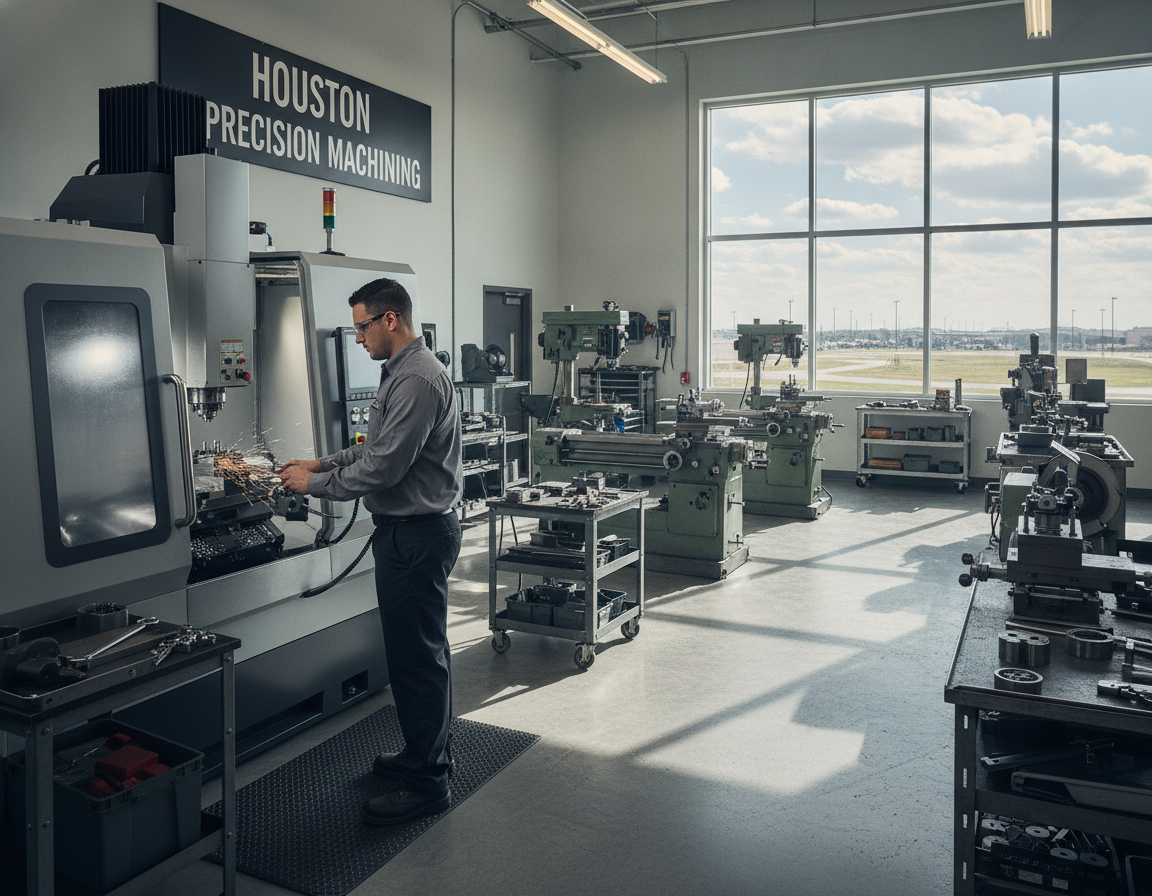 CNC Machine Shop Houston
Top Providers And What Sets Them Apart
Buyers in Houston can choose from a mixture of nearby machining firms and larger contract manufacturers with specialised technical capabilities. This supplier mix gives customers faster turnaround, direct collaboration, and simpler logistics than they may receive from distant manufacturers. The providers below demonstrate strong CNC capabilities as well as wider industrial-manufacturing services.
Lowrance Machine is recognised in Houston for responsive customer service and close working relationships. The business focuses on CNC milling, made-to-order machining, and fabrication while prioritising quick project completion. Because the company operates locally, customers can conduct in-person inspections, coordinate deliveries more easily, and respond quickly to project changes.
RBR Machine specialises in high-accuracy production, multi-axis machining, and associated manufacturing support. Backed by ISO 9001:2015, ISO 13485, AS9100D, and ITAR compliance, the firm manages projects from early-stage samples to complete assemblies. Capabilities such as rapid estimates, coordinate-measurement inspection, API threading, and rush manufacturing support energy, aviation, healthcare, and defence customers.
Centerline and comparable Houston-region manufacturers offer flexible capacity across prototype, limited-volume, and full-production programs. As a Houston-based contract-production company, Centerline maintains both ISO 9001:2015 and AS9100D credentials. Local contract-production firms reduce dependence on distant sources and provide faster, more resilient support for industrial-manufacturing programs.
Supplier selection should reflect the part geometry, quality credentials, anticipated quantities, and required delivery timetable. Work requiring complex 5-axis capability or large machining envelopes often fits providers with resources similar to those of RBR Machine. Projects dependent on close collaboration and short schedules may benefit from a customer-focused Houston machine shop such as Lowrance Machine.
| Provider | Principal Advantage | Key Certifications | Best Fit |
|---|---|---|---|
| Lowrance Machine Services | Custom CNC work, metal fabrication, and quick local service | Established manufacturing procedures and in-house quality checks | Made-to-order work requiring local communication and rapid completion |
| RBR Precision Machine | Complex precision machining with large-part and turnkey capabilities | ISO 9001:2015, ISO 13485, AS9100D, and ITAR | High-precision aerospace, defence, medical, and oil-and-gas components |
| Centerline Houston | Scalable contract-manufacturing support for varying order quantities | Certified ISO 9001:2015 and AS9100D systems | Long-term production work needing domestic sourcing and controlled quality |
The search for a Houston CNC partner should consider turnaround speed, quality systems, inspection technology, total price, and location. Local and regional firms support diverse market needs through experienced machining personnel, practical customer assistance, and extensive industrial services.
What To Evaluate In A CNC Machining Provider
The process of identifying a suitable CNC shop should include a thorough examination of its manufacturing resources, quality procedures, and service range. It is important to confirm that a provider uses current technology, follows stringent inspection procedures, and can reduce supply-chain complexity. Shops offering precision machining together with fabrication and downstream operations reduce handoffs by delivering parts prepared for the next production stage.
Precision machining services begin with the ability to maintain demanding dimensions consistently. Depending on the material, design, and intended application, common tolerance bands often fall between ±0.001″ and ±0.005″. Suppliers working in regulated sectors may provide Zeiss coordinate measurement, FAI documentation, optical checks, NDT, and material-hardness testing. Recognised quality certifications confirm the use of documented systems that simplify customer audits and formal acceptance processes.
Third-party coordinate-measuring services can independently verify critical dimensions without requiring the customer to change machining providers. Independent verification provides another layer of confidence without disrupting the established sourcing arrangement.
Sophisticated equipment expands the range of achievable geometries and helps accelerate manufacturing cycles. Five-axis machining in Houston reduces repositioning and setup counts while creating contoured parts used in aerospace, medical, and other precision applications. Wire EDM allows suppliers to cut fine slots, sharp profiles, and complex details in metals that conduct electricity. Large-format milling handles oversized energy and heavy-equipment components using machine beds that may exceed 100 inches in length and width.
Complementary processes increase the range of components a machining company can complete internally. Swiss machines excel with slender, detailed pieces, while heavy turning equipment supports substantial shafts and large-diameter work. A provider combining CNC milling in Houston with specialised turning and wire EDM can complete complicated groups of related components under one roof.
Turnkey manufacturing can save considerable time and minimise coordination problems between multiple vendors. Comprehensive turnkey services may include engineering support, prototyping, production machining, secondary operations, assembly, finishing, packaging, and logistics. Regional contract manufacturers frequently bundle plating, anodising, heat treatment, kitting, and supply-chain management within one purchase order.
Additional services have greater value when a project must move quickly. Fewer external operations are required when a shop offers priority service, finishing, and assembly within the same facility. Choosing a provider that combines turnkey manufacturing with metal fabrication and machining creates clearer accountability and better control of finished-part quality.
Selecting And Assessing A Houston Machining Provider
Begin by defining the project requirements in clear and measurable terms. Document anticipated part volumes, specify whether the work is developmental or production-based, and list every required material. The request should also address tolerances, cosmetic or functional finishes, inspection needs, and relevant compliance standards. Complete information allows a CNC machine shop Houston provider to prepare quotations faster and reduces the risk of expensive design changes.
Quality certifications and internal procedures should be reviewed carefully before selecting a manufacturer. Determine which recognised standards the shop follows, including ISO, AS9100D, medical-device certification, and defence registration where required. For precision work, documented certification helps ensure repeatable manufacturing and provides evidence required during customer audits.
Compare the component design with the machines, software, personnel, and processes available at each shop. Where needed, ensure the shop operates multi-axis centres, EDM equipment, precision turning machines, and large-bed mills. Also review CMM inspection capacity and secondary services such as heat treatment, plating, coating, fabrication, or assembly. Qualified suppliers should be able to prove their capability with equipment information, sample components, and relevant production experience.
The speed and reliability of the quoting process should be reviewed alongside expected manufacturing turnaround. Vendors capable of supplying prompt, transparent quotations and genuine rush options may reduce project risk. Transparent pricing and lead-time commitments are essential for managing rapidly changing production requirements.
Review how each shop measures parts, records results, and reports quality information to customers. Relevant documentation may include CMM results, first-article records, material traceability, and dimensional-verification reports. Established Texas industrial machine shops provide transparent quality records suitable for customer review and formal auditing.
The ability to communicate quickly and obtain nearby technical assistance can materially affect project success. Face-to-face design reviews, factory visits, and geographic proximity reduce logistics costs and accelerate problem resolution. Houston partners may provide greater sourcing flexibility and faster assistance when urgent production, repairs, or revisions are required.
Evaluate local and overseas quotations using total acquisition cost rather than unit price alone. Include shipping, duties, warehousing, delays, rejected parts, communication overhead, and revision costs in the calculation. Once hidden costs and market-launch timing are considered, custom machining from nearby shops may prove more economical than overseas alternatives.
Examine references, case studies, and the supplier’s history within relevant industries. Seek manufacturers with demonstrated success in energy, aviation, healthcare, vehicle production, power, or comparable markets. Ask to see components of similar difficulty and records showing reliable delivery during real customer programs.
A capable partner should provide continuing assistance and have enough capacity to increase output over time. The company should be able to move from development samples to sustained production and, where required, complete assembly or contract manufacturing. A scalable precision-machining service reduces the need to transfer mature products to a different manufacturer later.
Use a structured checklist to compare clear specifications, certified quality systems, suitable equipment, quotation speed, inspection records, local support, total cost, references, and scalability. Applying consistent criteria allows decision-makers to choose a Houston shop aligned with performance, schedule, quality, and financial requirements.
Cost, Lead Times, And Real-World Use Cases For Houston Industrial Machining
The price of machining in Houston varies according to design difficulty, selected material, required setups, and order size. Tight tolerances and secondary processes such as heat treatment, plating, coating, or inspection can add further expense. Intricate geometries and challenging alloys, including titanium, often require slower cutting, specialised tooling, and higher rates. Five-axis production carries greater upfront programming expense but may reduce overall cost through fewer operations and less repositioning.
Teams should evaluate both direct machining charges and the wider financial impact of sourcing. The complete expense may include coordination, transportation, stockholding, import charges, rework, and lead-time exposure. Local machining services in Houston can often reduce many of these expenses compared with overseas production.
Delivery schedules are affected by the selected provider, current production commitments, design requirements, and supporting operations. Companies offering rapid quotations and expedited scheduling can shorten prototype development and accelerate the beginning of production. Local CNC machining and milling normally involve fewer logistical stages and shorter travel distances than offshore sourcing. Local access enables customers to resolve problems quickly and place accelerated orders when unexpected requirements arise.
Work subject to strict industry requirements should be placed with shops maintaining formal quality credentials and coordinate-measurement resources. Documented controls and dependable inspection help prevent quality failures that could disrupt schedules or increase expense.
Real-world projects reveal how Houston machine shops support numerous demanding industries. Oil and gas programs often require large-capacity milling, pressure-resistant components, durable alloys, and heavy-duty machining. Aerospace and defence projects frequently require five-axis machining, AS9100D quality controls, detailed documentation, and precise inspection. Healthcare components may require delicate EDM features, small-diameter turning, medical-quality certification, and documented lot control. Power and renewable-energy equipment frequently calls for oversized machining, strong components, and heavy-duty finishing processes.
Providers that offer quick prototypes and end-to-end production support can move projects forward with fewer delays. The same provider may support initial samples, design refinement, production launch, finishing, and assembly with limited outsourcing.
For time-sensitive or compliance-intensive projects, prioritise local providers that demonstrate rigorous process control and dependable coordinate measurement. Components with intricate contours benefit from manufacturers that have demonstrated 5-axis expertise and robust programming support. Long-term programs or fluctuating demand may be better suited to scalable contract manufacturers that provide supply-chain flexibility. Buyers may achieve the best overall result by pairing local customer-focused support with regional suppliers offering advanced or highly specialised machining resources.